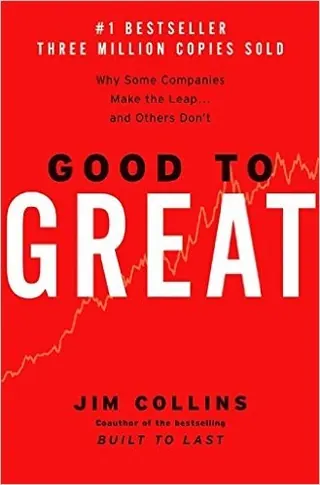
Good to Great
Collins and his research team studied companies that made the jump from good to great and stayed there, then worked backward to find what separated them from their peers. The answers (Level 5 leadership, getting the right people on the bus, the Hedgehog Concept, the flywheel) have become standard vocabulary for a reason. Some of the exemplar companies have since stumbled, which critics enjoy pointing out, but I read the book for the patterns, not the stock picks, and the patterns have held up in my own work.
“First who, then what” is the idea I have gotten the most value from. Early in my time as a CIO, at a commercial printer in Atlanta, we were paying a managed service provider around $400K a year for mediocre coverage. The fashionable answer was to renegotiate or switch vendors. The right answer was one exceptional internal hire at roughly $70K. That decision only made sense if you believe, as Collins argues, that one right person outperforms a contract full of interchangeable ones. It saved about $330K a year, and more importantly it changed what the IT function was capable of taking on.
The flywheel is the other pattern I see constantly. There was no single breakthrough moment in any turnaround I have been part of; there was a long sequence of unglamorous pushes in a consistent direction, each one making the next slightly easier, until momentum became visible from outside. The book’s warning about the doom loop, lurching between programs and saviors, describes half the failed transformations I have watched from a distance.
Level 5 leadership, ambition for the institution paired with personal humility, is the standard I would want to be measured against. Still the first book I suggest to leaders thinking seriously about what sustained excellence requires; disciplined people, disciplined thought, and disciplined action compound, and there is no shortcut around the compounding.