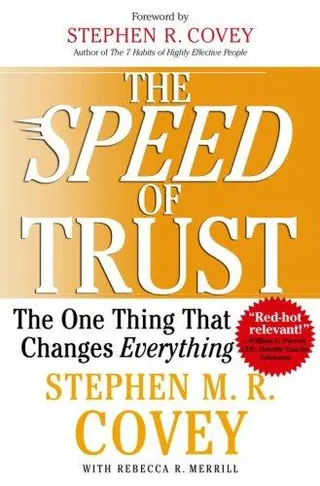
The SPEED of Trust
Covey’s argument is that trust is not a soft skill; it is an economic driver with measurable effects. When trust goes up, speed goes up and cost goes down. When trust goes down, everything gets slower and more expensive, because low trust forces verification, contracts, escalation, and second-guessing into every transaction. He calls that a tax, and once you start looking for the trust tax in an organization you see it everywhere: the approval chain that exists because of one incident years ago, the meeting held to prepare for the real meeting.
The book’s structure holds up in practice. Trust rests on both character and competence, and Covey is right that leaders tend to overweight whichever one they personally have. Integrity without delivery does not earn trust; neither does brilliance from someone who shades the truth. The thirteen behaviors are more concrete than the usual list, and the two I have gotten the most from are “talk straight” and “practice accountability.” Delivering bad news early and plainly, and owning misses before anyone asks, buys more organizational speed than any process improvement I know.
I have watched the economics work in both directions. Inside a company, a technology team that consistently does what it says can shorten client response times dramatically, because nobody upstream feels the need to check the work or route around it. Externally, the same principle is why we invested years in formal security certifications: an audited attestation is trust made portable. A client who can verify your controls extends trust on day one instead of month six, and deals move at the speed of that verification.
This book changed how I approach leadership and relationship-building. Once you see trust as something you can deliberately build, measure, and repair, you stop treating it as a byproduct and start treating it as the work. Recommended for any leader trying to understand why their organization moves slower than it should.