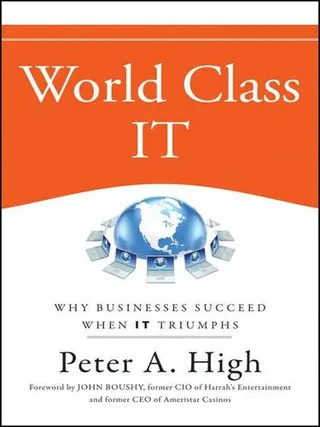
World Class IT: Why Businesses Succeed When IT Triumphs
High studied top-performing IT organizations and distilled how they operate into five principles: recruit and develop the right people, build reliable infrastructure, manage projects and portfolios well, run vendor partnerships deliberately, and align the whole function with the business. Each principle comes with sub-disciplines and metrics, so the book works as an assessment tool, not just a philosophy.
The ordering is the real argument, and I think High gets it right. An IT organization earns the right to do strategic work by being boring first. Nobody invites you to shape revenue plans while email is down and projects run late. I lived this sequence personally: my career started in infrastructure, keeping systems running for organizations that noticed IT only when it failed, and every strategic role since was built on credibility banked during that unglamorous stage. The same holds organizationally. The interesting work my team does now, client integrations, platform consolidation, commerce systems that clients depend on daily, only became possible after the fundamentals stopped being a topic. When reliability is assumed, the conversation moves to what technology can create.
The chapter I recommend most to peers is the one on vendor partnerships, because it is the discipline IT leaders most often treat as procurement rather than management. A vendor relationship left on autopilot drifts toward the vendor’s interests; renegotiated and managed deliberately, the same relationships have funded meaningful investments elsewhere in my budgets over the years.
The examples date to the book’s writing, so read it for the model rather than the technology references. As a maturity model it holds up well: score your organization honestly against the five principles and the result usually explains why the business treats IT the way it does.
Worth reading for IT leaders at any level, and for business executives who want to understand what a good IT function looks like from the inside, and why demanding strategy from a function still fighting fires never works.